Chuck Norris Didn’t Need a Seed Round
What the World’s Most “Memeable” Man Can Teach Startups About Organic Growth
Written by Callais Capital Editorial
Chuck Norris doesn’t go viral. The virus goes Chuck Norris. It’s a joke, of course, one of thousands that have circulated the internet for over two decades. But beneath the absurdity of “Chuck Norris Facts” lies one of the most fascinating case studies in organic growth the digital age has ever produced. And for founders and venture capitalists alike, there are surprisingly real lessons hiding inside the roundhouse kick.
The Origin Story Every VC Dreams Of
In the early 2000s, something remarkable happened. Without a marketing budget, without a PR agency, and without a single dollar of venture funding, Chuck Norris became one of the most recognizable brands on the internet. Not because of a new movie or TV deal, but because of a grassroots, user-generated meme movement that spread like wildfire across forums, email chains, and eventually every social media platform on the planet.
The “Chuck Norris Facts” phenomenon — Chuck Norris can divide by zero; Chuck Norris counted to infinity… twice — started on a college campus message board and snowballed into a global cultural moment. It was the kind of product-market fit that would make any seed-stage investor weep with joy.
No growth hacker engineered it. No algorithm amplified it (at least not initially). It was pure, uncut organic traction: the holy grail of early-stage startups.

Community-Led Growth Before It Had a Name
Long before “community-led growth” became a Silicon Valley buzzword scrawled on pitch deck slides, Chuck Norris Facts were demonstrating its core principles: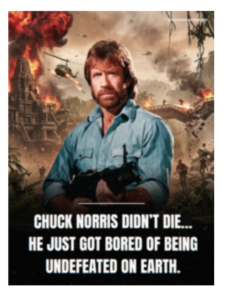
- The product was inherently shareable. Each “fact” was bite-sized, funny, and infinitely remixable. It cost nothing to consume and nothing to distribute. The best startups build products that practically beg to be shared, like Dropbox’s referral program or Slack’s viral team adoption loop.
- Users were the creators. Nobody waited for “official” Chuck Norris content. Fans made their own. This is the same user-generated content flywheel that powered YouTube, TikTok, and every successful marketplace. When your community builds for you, your CAC approaches zero.
- It tapped into an existing emotional reservoir. Chuck Norris was already a cultural icon, action star, martial arts legend, Walker, Texas Ranger. The memes didn’t create affinity from scratch; they reactivated it in a new format for a new generation. Smart founders don’t invent demand; they find it dormant and wake it up.
The “Unfair Advantage” That Wasn’t on a Cap Table
VCs love to ask about a founder’s “unfair advantage.” Chuck Norris’s was decades in the making, an authentic personal brand built on real accomplishments, a body of work that spanned entertainment, athletics, and even military service. You can’t fabricate that kind of credibility in a WeWork conference room.
For startups operating in regions like the Third Coast and Gulf Coast corridor, this lesson resonates deeply. The founders here aren’t parachuting into a market with a clever thesis. They’ve lived it. They have generational knowledge, local networks, and an intuitive understanding of their customers that no amount of market research can replicate. That’s the kind of unfair advantage that spreads like a Chuck Norris meme on the early internet.
What Chuck Got Right That Most Startups Get Wrong
Here’s the part nobody talks about: Chuck Norris leaned into it.
He didn’t send cease-and-desist letters. He didn’t try to “control the narrative.” He embraced the meme, wrote a book about it (The Official Chuck Norris Fact Book), and turned an organic cultural phenomenon into a licensing and media opportunity. He monetized after the community validated the concept and not before.
Too many startups do the opposite. They over-monetize before they’ve earned trust. They gate content before they’ve built an audience. They try to own what should be open.
The Chuck Norris playbook? Let the community run. Then build the business on top of the momentum.
The Takeaway for Founders and Investors
The next time you’re evaluating a startup — or building one — ask yourself: Is this a Chuck Norris, or is this a paid ad? Is the product generating genuine enthusiasm that spreads without incentive? Are users telling their friends because they want to, not because they’ll get a $10 credit? Is there an authentic story underneath the growth curve?
Because at the end of the day, you can buy impressions, but you can’t buy a meme. You can manufacture buzz, but you can’t manufacture legend.
Chuck Norris didn’t need a seed round. But if he’d taken one, the returns would have been infinite.
After all, Chuck Norris’s IRR doesn’t have a multiple. It has a belt rank.